His given name is Yanrianus Tiranda. Pong Intan is a teknonym.
Roxana Waterson, Paths and Rivers (Leiden: KITLV Press, 2020), 182.
“Pong Pika” and “Pong Ungga” are the teknonyms of Ne’ Lembang and Ne’ Camban, respectively.
Here, if I may speak to my own case, I would say that I am a stalk grafted onto that root.
Roxana Waterson, Paths and Rivers (Leiden: KITLV Press, 2020), 183.
At the end of 2023, past Christmas, the New Year was truly drawing near. While December in Korea ushers in "the season of cold" (winter)1, Toraja's tropical climate instead grows warm with the liveliness of "festival season." So it was at Tongkonan Rumbae', nestled in the mountainside of the Mandetek region. This newly completed house was built on the very site where the couple Ne' Pokkate' once lived, long ago. Now this house was about to be declared the tongkonan—the house of all the descendants who long for that couple—through the ceremony of mangrara (T), in which the blood of many pigs is shed as a representation of kinship's blood.
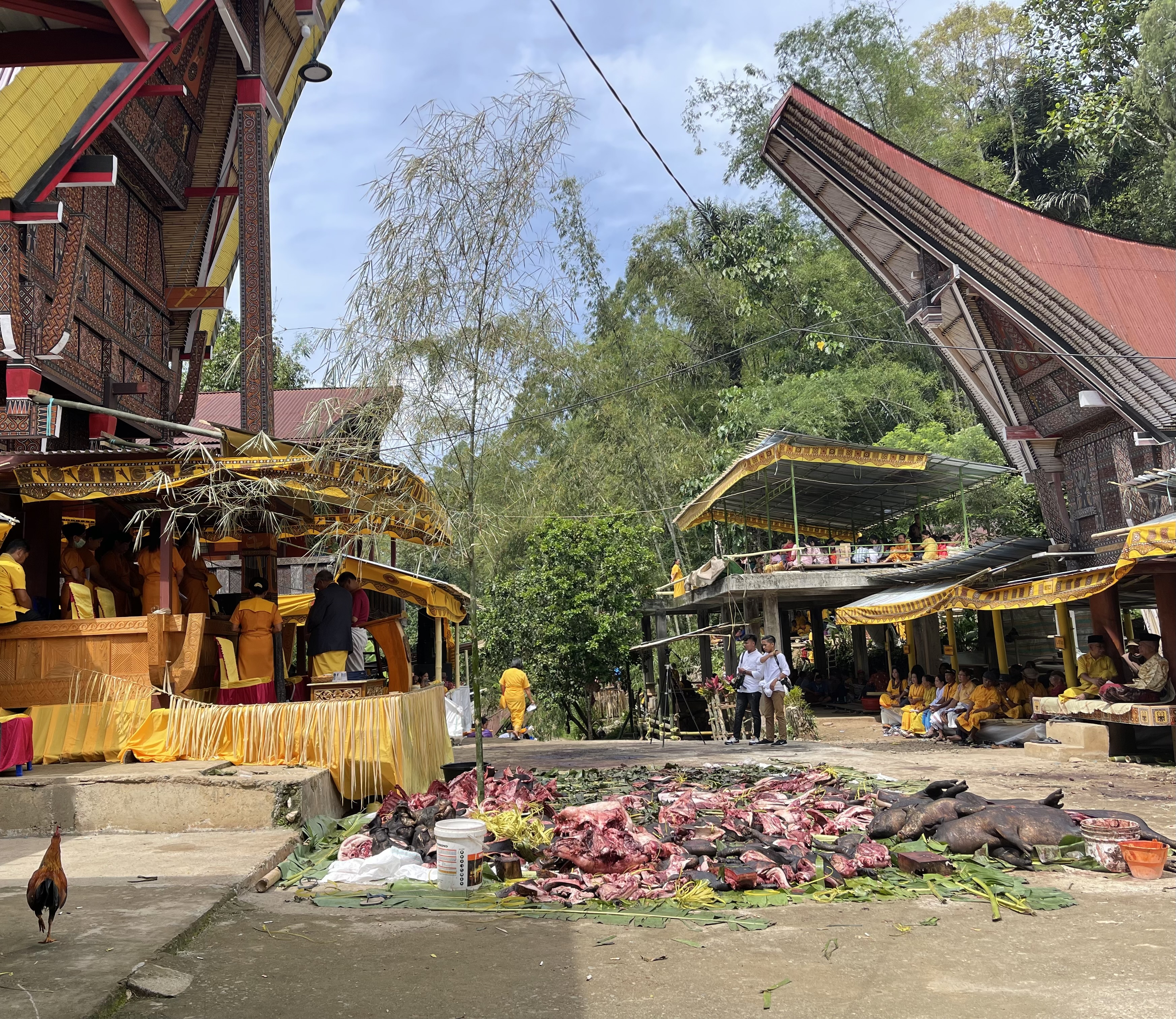
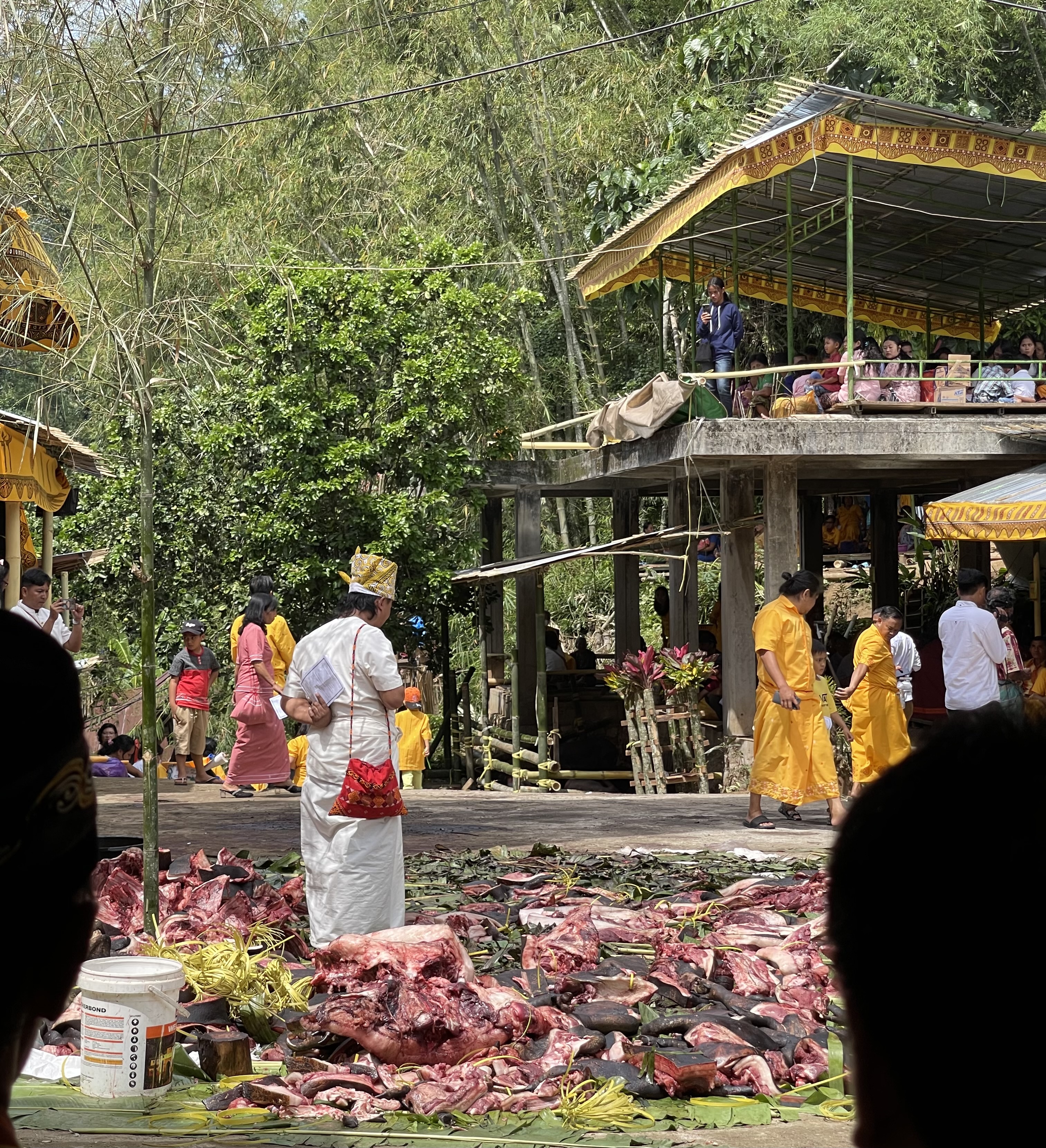
On the morning of December 28th, I made my way to Tongkonan Rumbae' at the invitation of the senior pastor of Tamben Church, a descendant of Ne' Pokkate'. This was the second and "climactic" day of a mangrara feast held over two days2. By the time I arrived, the ceremony was just about to begin. The front yard of the tongkonan was lined with the slaughtered and butchered carcasses of pigs, the sharp scent of blood hanging in the air3. People bustled about, preparing for the imminent ceremony; others sat gathered here and there around the yard. Guided by the pastor, I too took a seat from which I could view the ceremony well. Before long, the ritual orator Pong Intan4 stepped out into the midst of the pig carcasses and stood with his back to the eaves of the tongkonan. In a low voice, he began to recite the ma'parapa' (T)—the opening oration that announces the start of the ceremony.
O Sun, O moon, O firmament thick with stars
...
Now I shall carry the words of the noble descendants, and bear across the words of the forebears
...
[My lips] are joined to the lips of a multitude [like] a bamboo bunch
And touch upon [the mouths of] all the people [luxuriant] like a bamboo colony
"People [like] a bamboo bunch" and "all the people [like] a bamboo colony" form a parallel couplet referring to the kinship group hosting the mangrara. The bamboo species called tallang (T) grows in clusters of many stalks sharing one root system, called rapu (T; cluster, bunch). Likewise, to ma'rapu tallang (T; people [like] a bamboo bunch)—a human cluster—is a group of "descendants = stalks" who share the same "ancestor = root."5 The ritual orator never speaks only with his own "lips," his own "mouth." He joins his lips to the lips of his kin, luxuriant as a "bamboo bunch," carrying below him "the words of the noble descendants" and bearing above him "the words of the forebears." He is the rapu's spokesman, the rapu's representative.
Pong Intan's voice, low at first, gradually rose, growing as dense as a forest and enveloping the gathered crowd. Now he greeted every being surrounding Tongkonan Rumbae'—from "the center of heaven" to "the ends of the earth," from the highest-born nobles to the wandering strangers who had come merely for a share of the feast.
Hail to the center of heaven, hail to the great lord who watches over [all things]
...
Woheui- hail to the golden land’s end in the south
Hail to the vast earth
...
Hail to great and small alike
Hail to high and low alike
Hail to middle branch and crown alike
Whether great tree or young sapling
None of you do I leave outside the wall, outside the house
As this long greeting began, the "bamboo bunch" represented by Pong Intan appeared beneath the eaves of the tongkonan. Children from the church youth group, dressed in the traditional attire of dancers and musicians, followed by the procession of robed pastors, led the way as the descendants of Ne' Pokkate' marched in together. As Pong Intan, speaking for the rapu, intoned his resounding greeting, they too crossed the front yard of the tongkonan, offering a silent greeting to the assembled crowd—leaving out no one, whether "great or small," "high or low," that is, putting no one "outside the wall, outside the house." Just as the descendants of Ne' Pokkate' resembled a bamboo bunch, those gathered for the mangrara feast resembled a forest mingling "great trees" and "young saplings." This polyspecific forest had gathered in the front yard of Tongkonan Rumbae'—within the tongkonan, swollen large with vitality.

Almost as soon as the procession of the rapu came to an end, so too did the long greeting. Pong Intan crossed back over the pig carcasses to the other side and continued his oration, now facing the tongkonan. The oration moved into the passage called sampa' banua (T)—literally, "unfolding the house." Now Pong Intan recounted the story of the "house," including the history of the tongkonan's founding. He first summarized the history of the Mandetek region, then continued:
Woheui─
Truly clever was Ne’ Pokkate’, wise was Tumba’ Malaa
Truly clever was Matutu’, wise was Ne’ Tambalong
They knew the land of manifold blessing, the land like a broad rock
They built a house, drove in [posts] and raised a dwelling
Days passed, months passed, years passed
And the roof, [hard as] stone, that Pokkate’ and Tumba’ Malaa had built, decayed
And the sturdy well that Matutu’ and Tambalong had dug, decayed too
The couple Ne' Pokkate' and Tumba' Malaa settled and built their house on "a land of manifold blessing, a land like a broad rock"—that is, Mandetek. In this house, together with their child Matutu' and son-in-law Ne' Tambalong, they built a family. But this house, as "days passed, and months passed, and years passed," saw its "roof decay" and its "sturdy well decay" as well. There were, however, descendants who rose up to rebuild this crumbling ancestral house—Ne' Lembang and Ne' Cambang, the very ones who led the founding of Tongkonan Rumbae'.
Truly clever was Pong Pika, wise was Ne’ Lembang
Truly clever was Pong Ungga6, wise was Ne’ Cambang
With the cleverness that sends forth the rooster’s crow, and the wisdom that asks with a fighting cock’s spirit
To the multitude [like] a bamboo bunch, to all the people [flourishing] like a bamboo colony
To the noble descendants of Tonkonan Rumbae’ [they said]
...
“Let us make this house firm here, and raise its long eaves”
What is notable here is that the founding of Tongkonan Rumbae' is not spoken of as the construction of a new house. In purely physical terms, this tongkonan is, without question, an entirely new building. There is no possibility that the house of Ne' Pokkate' and his wife—distant ancestors eight generations above Ne' Lembang's generation—still retains its original form. And yet, speaking through the mouths of Ne' Lembang and Ne' Cambang, Pong Intan declares that they will "make the house firm" and "raise its long eaves"—as though merely adding something to a house that has, all along, properly existed.
Waterson wrote that the Torajan house possesses "immortality7/" Indeed, in the passage above, Pong Intan tells how the house Ne' Pokkate' built endured across the long years and finally became a tongkonan, crowned with its "long eaves"—sustained by the "cleverness" and "wisdom" of descendants flourishing like a "bamboo bunch." Long ago, this house, like all Torajan houses, must have been called by a person's name—"Ne' Pokkate'." Now, to this "Ne' Pokkate'," a new name has been added: "Tongkonan Rumbae'." The house itself is not new. What is new is the status of tongkonan acquired together with the "long eaves," and the name "Tongkonan Rumbae'."
How is it that the house "Ne' Pokkate'" can remain "immortal" to this day? Why, despite having physically vanished entirely, is it still considered to endure? Let us turn back in time to the passage in which Pong Intan recounts the history of the Mandetek region.
Woheui-
Truly clever was Puang Rambu Langi’
Wise was Arring, great tree of Deata (another name for Mandetek)
[Puang Rambu Langi’] with cleverness planted a great tree, with wisdom raised a juniper and let it grow in every direction
Its branches stretched all around, its roots crossed the lake
Woheui-
The blessed land, the land of Madetek whole as a broad rock
Is land marked out by the ancestor who kept the rites, the forebear who wound [the law] onto its spool
The legendary history surrounding the founding of Mandetek, a "custom territory8," is recounted here in compressed, poetic form. Unpacked, the story runs as follows. Long ago, there was an ancestral deity named Puang Rambu Langi'. Like most Torajan ancestral deities bearing the title Puang, he descended from heaven. Puang Rambu Langi' descended upon a mountain near Mandetek and planted a "great tree." The "great tree" that appears throughout Torajan ritual language is at once tree, person (or persons), and house. To say he "planted a great tree" is to say that Puang Rambu Langi' himself took root on the earth and built his house upon it. Living in this house, he spread his descendants far and wide—growing, in this way, into a "great tree" with branches and leaves stretching upward and roots spreading widely below. The greatest branch to grow from this great tree was Arring, the founding ancestor of the Mandetek region. He became "the ancestor who kept the customary law, the forebear who wound the law onto its spool," and thereby "demarcated" the custom territory of Mandetek.
This is a history written by a forest of representation, in which people, plants, and houses each stand for one another. People take root in the earth and stand like trees. Just as a tree is planted in the earth, a house is built upon it. Earlier I wrote that relationships between people are relationships between houses. The same holds true within a kinship group. For a kinship lineage to continue, children must build houses just as their parents did, and descendants must build houses just as their ancestors did. People beget people; houses beget houses; and as branches grow out from a tree, the history of a kinship group grows with them. So it is with the lineage that runs from Arring, the founding ancestor of Mandetek, to Ne' Pokkate', and from Ne' Pokkate' to Ne' Lembang. Within this story—at once genealogy and history—even as Ne' Pokkate' died and the physical form of the house called "Ne' Pokkate'" crumbled away, his house endures, perpetuated through the lives of his descendants.
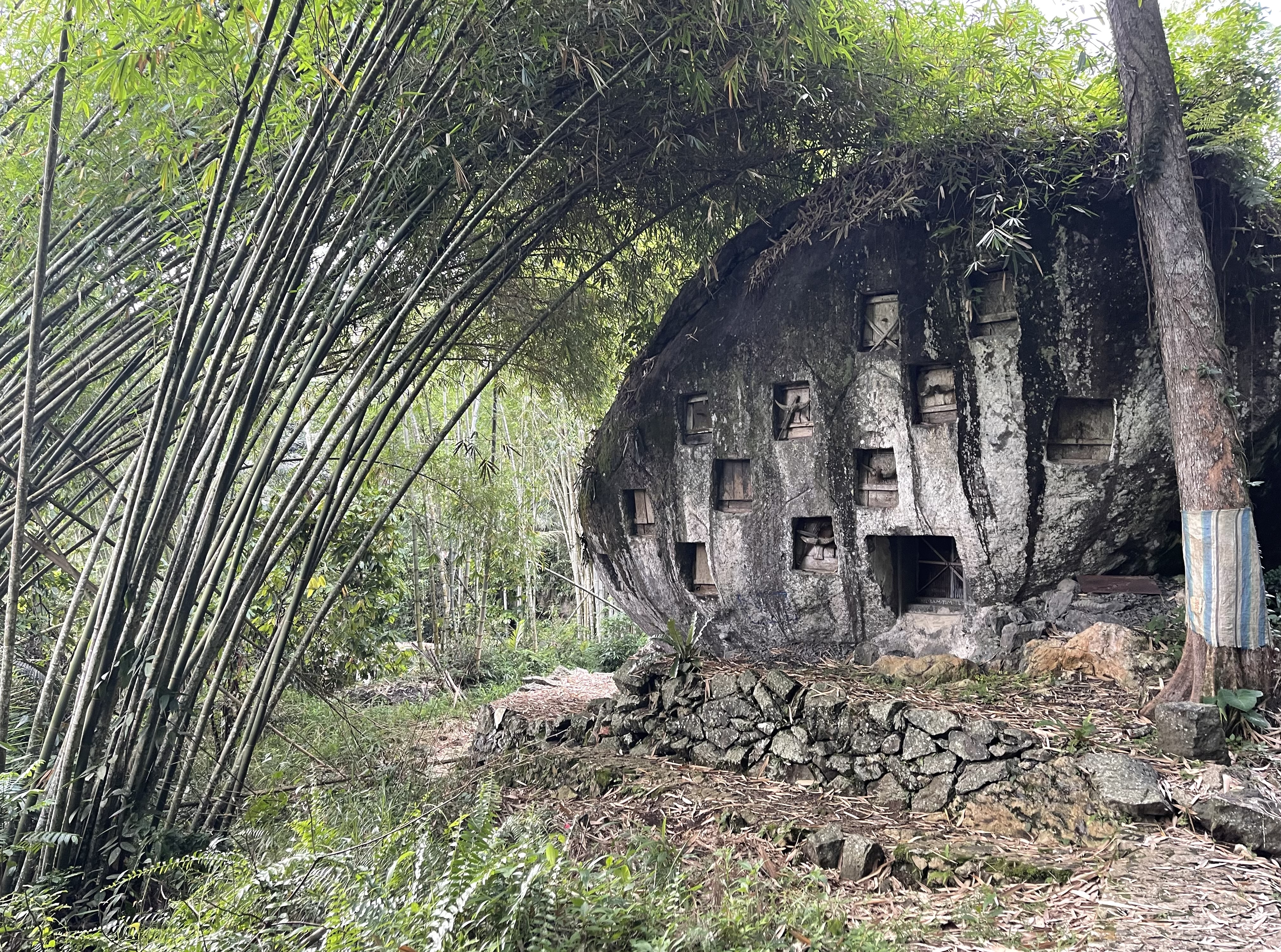
The kin of "Tongkonan Rumbae'," for whom Pong Intan speaks, is a great tree that has grown through just such a history. As we saw in the oration above, this great tree is also a "bamboo bunch" (rapu). A great tree with luxuriantly spreading branches represents kinship even as it stands interchangeable with the image of bamboo stalks branching out from a shared root. This image of the bamboo bunch appears not only at the scale of kinship belonging to a tongkonan, but at the level of smaller family units as well.
So it is with "our" house in Pani' village9, "Mama Juli." This house has as its root Mama Juli and Papa Juli, and as its stalks—sharing that same root—the three daughters who live together there10. Right now, the eldest of these stalks, Juli, is beginning to grow out into a new house. Married and still living together in Mama Juli's house, Juli and her husband11 began building their own house after the birth of their son, Rey. At the same time, they themselves are being built, house-like. They are no longer called by their individual names, "Juli" and "Ronal," but by the names "Mama Rey" and "Papa Rey," taken from their son's name. When the house of Mama Rey and her husband is eventually completed, it too will be called "Mama Rey" or "Papa Rey." Their names become the names of their house, and so they become "one house" relating to other houses.
In Toraja, a person becomes a proper "person"—an adult—only by marrying, bearing children, and building a family. This is the same as building a house and becoming a house-like person. Building a family and building a house are referred to together by a single expression, untanan dapo' (T). Dapo' (T) means kitchen; untanan (T) refers to the act of planting—in this case, planting the kitchen hearth as though planting a tree. To build a family is the same as building a house centered on the space responsible for the household's livelihood: the kitchen. A child grows out from the parents' house by "building" their own house and family. And yet, even as the child grows out, the relationship of root and stalk between parent and child is never severed. However far a bamboo stalk extends, it never detaches from the root fixed in the earth. The parents' house, too, remains forever as the descendants' root—a house always longed for, a house to which one must continually return. Even as "Mama Rey" grows out from "Mama Juli," "Mama Juli" will remain a house to her child Mama Rey, and to her grandchild Rey as well. Bit by bit, in this way, "Mama Juli" is becoming an ancestral house longed for by its descendants. It is becoming, one hopes, a tongkonan.
Just as Mama Rey is becoming a house, Mama Juli's other two daughters, Ica and Seli, are expected someday to marry and build houses of their own as well. And so they too are each, potentially, "one house." Every house is thus, in itself, a cluster of many "one houses"—a forest of houses. This forest is immortal so long as its root, and the land in which that root is fixed, are remembered. It is immortal so long as there are stalks that long for their roots. Eternally immortal, this forest aspires to grow into a great bamboo bunch, a rapu, and so to become a tongkonan.
So it was on December 28th, 2023, with Tongkonan Rumbae'. The "people [like] a bamboo bunch," the "all the people [like] a bamboo colony," gathered that day in the front yard of the tongkonan, were every one of them people who had their own house—or who were, to some degree, themselves a house. They were houses. The tongkonan is the glorious status that a forest of houses comes to acquire—one culmination in the life history12 woven by people, plants, and houses, each representing the others.