The kinship group that constitutes the membership of a tongkonan. See Part 3.
T: tongkonanna sangdunduan pindan, esunganna to sangirusan gori-gori.
In what follows, portions in bold are in Torajan; the rest is in Indonesian.
“Blood and bones” (T: rara buku) is a Torajan expression referring to the bonds of flesh and blood.
John L. Austin, How to Do Things with Words (London: Oxford University Press, 1962).
4. House of Word
From the center of the heavens, may the Lord’s blessings [like] a golden bracelet,
the blessing we await, cross over to us;
from the navel of the firmament, may the Creator’s golden, luxuriant grace,
the grace we look up to, swim over to us;
then we shall all be blessed, our bodies shall be blessed.
Come,
come,
come, O vitality of perfect grace
Rejoice, you who would rejoice
Clap your hands, you who would clap
Wo-ho ho ho hei
“Wo-ho-ho-ho hei!” The crowd's exuberant echo rings out in response. So concludes Pongintan’s1 speech, which had resounded for some thirty minutes. Pongintan's vigorous and "luxuriant" voice produced the most "traditional" scene of the day's mangrara festivity. His speech ended with a decidedly Christian invocation of blessing, yet its resonance with traditional language persisted to the very last. Even the expressions used to convey Christian concepts—"blessing [like] a golden bracelet," "the navel of the firmament," "luxuriant grace"—retained the diction of an archaic ritual language.
The opening speech by the ritual orator, generically called ma'parapa', announces to the assembled crowd the commencement of the ritual and prepares them for the ceremonies to follow. Pongintan's speech may have ended, but the mangrara has only just begun. Above all, the "main part" of the mangrara ritual is yet to come. If one were to follow the "pure" tradition predating the arrival of Christianity, a ceremony in which pig's blood is sprinkled on the house building to proclaim the birth of a new tongkonan should follow. But the ritual of a people who have embraced the Gospel is a different matter. The pagan ceremony of sprinkling animal blood runs counter to Christian providence. Instead, "we" Christians hold a worship service—a ritual in which we pay reverence to "the Lord" and "Creator."
The festivity of Tongkonan Lumba'et moved into the order of worship for the mangrara "service." As a Torajan-language hymn rang out as the introit, the session delegates dispatched from the Rante To'long Church straightened their attire and adjusted their posture beneath the tongkonan's eaves. Elder Pastor Yusuf2, who had been sitting among them, came forward and took the podium. The pastor proclaimed the beginning of the worship in Indonesian, the national language and the primary language of the Toraja Church:
This worship is held in the name of the Father, the Son, and the Holy Spirit.
This was the first standard Indonesian phrase to be publicly used in the mangrara ritual of Tongkonan Lumba'et. This short declaration, called the votum (I: votum), forms a fitting contrast with Pongintan's speech, which had been delivered entirely in archaic Torajan, and signals that Indonesian will be the primary language of the worship to follow. At the same time, this declaration ushers the crowd into a markedly different, solemn atmosphere. The front yard of the tongkonan, where the names of the ancestors had been ringing out, became the reverent sanctuary of Christians who honor the name of "the Father, the Son, and the Holy Spirit." The crowd responded by singing a short hymn with the lyrics "Amen, amen, amen" and adjusted their posture. Men put out their cigarettes; women stopped the pleasant chatter they had been having with their neighbors.
Up to this point, the protagonists of the mangrara ritual had been, without question, Tongkonan Lumba'et and its rapu3, and their spokesperson Pongintan. With the beginning of the worship, another set of protagonists came to the fore: Pastor Yusuf, who would officiate the service, and the Rante To'long session delegates who would assist him. The people gathered in the front yard of the tongkonan at the time fell broadly into two groups: the rapu of Tongkonan Lumba'et, and the guests who had come at the rapu's invitation. Either way, each had come representing their respective houses, in the name of their houses. From which "house" had Pastor Yusuf and his party come? They, too, had come at the rapu's invitation, but not merely as "guests." They had come from a church—called "the house of God"—as people representing that church.

In Toraja, the church is referred to by several alternative names. In addition to "the house of God," which is grounded in Scripture, distinctly Torajan appellations that refer to the tongkonan—such as "a big tongkonan"4 and "tongkonan for all"5—also refer to the church. What "tongkonan" means here differs from a tongkonan in the ordinary sense. A tongkonan is the house of the ancestors and the house of descendants who carry on the ancestral bloodline. Likewise, the church as a "tongkonan" is the house of those who carry on a certain "bloodline," and the house of "God the Father" who stands at the apex of that bloodline. Yet this bloodline is a spiritual one that transcends secular bloodlines—a bloodline of faith, so to speak. "To all who received him, who believed in his name, he gave power to become children of God, who were born, not of blood or of the will of the flesh or of the will of man, but of God" (John 1:12–13)6.. The church is the house of "all who believed"—that is, "children of God." Since the potential scope of these "children" extends to all Christians throughout Toraja and, further, to all the believers the world over, the church is "a big tongkonan" and a "tongkonan for all."
The "name" in which they believe is, of course, the name of Christ Jesus. But Jesus has another name. "In the beginning was the Word" (John 1:1). This Word, which "was with God" from the beginning and was also God himself, "became flesh" (John 1:14)—and that is Jesus. Christians are those who believe in this Jesus. Their belief should not be merely an inner state of mind, but also a practice—that is, of participating in worship, a ritual in which they revere the God who is "the Word" they believe in. Worship is also, in a literal sense, a ritual in which the "Word" of God is proclaimed. Protestant7 worship centers on the liturgy of the "Word": the reading of Scripture—the book in which the "Word" of God is written—followed by the pastor's explication of the passage in a sermon8. In Christianity, a religion thoroughly devoted to the "Word," the "Word" is at once the name of God, the speech of God, and the ritual in which that speech is discoursed upon.
Every Sunday, and also on Christian holy days such as Christmas, the church is the house in which this polysemous Word is proclaimed—the House of Word, so to speak. Pastor Yusuf and the Rante To'long session had come as people of this "House of Word," carrying the Word to Tongkonan Lumba'et. The Word they proclaimed in the service that day was drawn from the Apostle Paul's letter to the Colossians (Col. 3:12–17):
As God’s chosen ones, holy and beloved
...
Just as the Lord has forgiven you,
so you also must forgive
Above all, clothe yourselves with love,
which binds everything together in perfect harmony.
And let the peace of Christ rule in your hearts,
to which indeed you were called in one body.
....
Let the word of Christ dwell in you richly
This is the passage from the Indonesian Bible that Pastor Yusuf read aloud. It was clearly read in the pastor's voice, but it is not the pastor's own "words." This is the Word. The "word of Christ," which the Apostle Paul conveyed under the inspiration of God's Word, was now proclaimed by Pastor Yusuf to the crowd gathered in the front yard of the tongkonan. You "God's chosen ones," forgive one another. Love one another. Become one body in peace. Live lives rich with the Word. And so, in the language of ritual, this place becomes worthy of the church's appellation: "tongkonan of those who wet their lips from one dish, the seat of those who drink from one cup." It becomes the "seat"9 where the assembled crowd "wets their throats" with the Word served on "one dish"—a tongkonan (literally, "place to sit in"). This house, which is the house of the ancestor Ne' Pokkate and now aspires to become Tongkonan Lumba'et, first becomes a House of Word in the likeness of the church.
Earlier, Pongintan had used the ritual language of the Torajan tradition to paint a forest of people, trees, and houses that grow by representing one another. He painted Tongkonan Lumba'et as precisely such a forest. At the same event, the Word that Pastor Yusuf proclaimed paints the life of Christians who stand in solidarity through "forgiveness," "love," and "peace." Yet it paints in a markedly different language from Pongintan's. In the forest of Torajan ritual language, people, trees, and houses resemble and point to one another. That is sufficient. When people and houses grow luxuriant like trees, there is already a forest, and there is already a tongkonan. By contrast, the Christian vocabulary that embroiders the Word—words such as "forgiveness," "love," and "peace"—does not speak through resemblance and pointing. It speaks through symbols. Peirce called "symbol" a sign that represents something only through its abstract relations with other signs—the kind that fills much of human language10. "Forgiveness," "love," and "peace" are indeed of this kind: these words represent Christian solidarity through the semantic system of Christian discourse. The Word speaks with symbols.
Yet the Word must at the same time come to resemble the forest—the forest of the "life history" that Pongintan narrated, and Ne' Pokkate's house, which is soon to become a "tongkonan" through the mangrara ritual. For the Word that Pastor Yusuf proclaimed is itself a passage within the mangrara held for that very house. Just as Ne' Pokkate's house took root in the earth as people, trees, and houses, the Word must take root in the "context" of the mangrara, here and now. Only then can it become the Word for Tongkonan Lumba'et. The sermon that followed was largely devoted to explicating the Word conveyed by Paul within the context of the mangrara. The pastor's sermon exemplified the "contextual" (I: kontekstual) preaching that pastors of the Toraja Church aspire to. The pastor said, mixing Torajan and Indonesian:11
It is not to shed the blood of livestock that we have gathered
It is to bind us with the blood and bones [of kinship] 12and make us strong
It is to strengthen the bonds of flesh and blood
If we are strong in the bonds of flesh and blood
then joy, peace, and prosperity will naturally follow
...
But the bonds of flesh and blood must be built on love.
Only then is peace made.
And true love comes from God.
God is love.
Pastor Yusuf invokes the mangrara—the ritual of "shedding the blood of livestock"—as the context for the Word. At the same time, he negates a certain part of that context. The shedding of animal blood itself, he says, is not the purpose of this gathering. There is a paradoxical resonance in these words—a paradox produced by the intersection of the vivid red of pig's blood filling the front yard, the occasional sharp smell of raw meat stinging the nose, and the pastor's sermon declaring that none of this is the reason "we have gathered." There is, of course, a reason for this. The pastor has in mind the pre-Christian version of mangrara: the ceremony in which pig's blood is sprinkled on the tongkonan building in the hope that blessing may descend from the spirits of the ancestors. This cannot be condoned in a Christian church. All sovereignty belongs to God; the power to bless, too, belongs to God. The moment one attributes such power to the blood of livestock and the spirits of ancestors, "we" become pagans. The rich red of blood and the smell of flesh may suffice for the worship of idols, but something more is needed if they are to be reconciled with the proper way of serving God.
Thus the pastor puts forward not the blood of livestock but another kind of blood—the blood of flesh and kinship—as the medium that will sustain the "joy, peace, and prosperity" of Tongkonan Lumba'et. This blood is also a medium of Christian "love." Pastor Yusuf equates the "love" that Paul described as that "which binds everything together in perfect harmony" with the medium of kinship bonds that the mangrara celebrates—namely, "blood and bones." In this way, the Word is "contextualized."13 "Forgiveness," "love," and "peace" enter the "context" of a ritual that "strengthens" the tongkonan through the bonds and love among flesh and blood, a "true love" that "comes from God." And so Tongkonan Lumba'et, too, becomes a "context" for the Word—a "house" of the Word.
How, then, should the ceremony that consecrates a tongkonan as a tongkonan be carried out? In other words, through what performance does a tongkonan become, in name and in fact, a "tongkonan"? In the pre-Christian mangrara, this was a simple matter. The literal meaning of mangrara is the sprinkling of blood, rara. Sprinkle pig's blood on a house with long eaves raised, and it becomes a tongkonan. In the forest of representation where like represents like, pig's blood readily stands for the blood of kin and the blood of ancestors. Through this blood as medium, the tongkonan becomes the house and the body of the rapu. But Christians cannot perform this kind of mangrara.
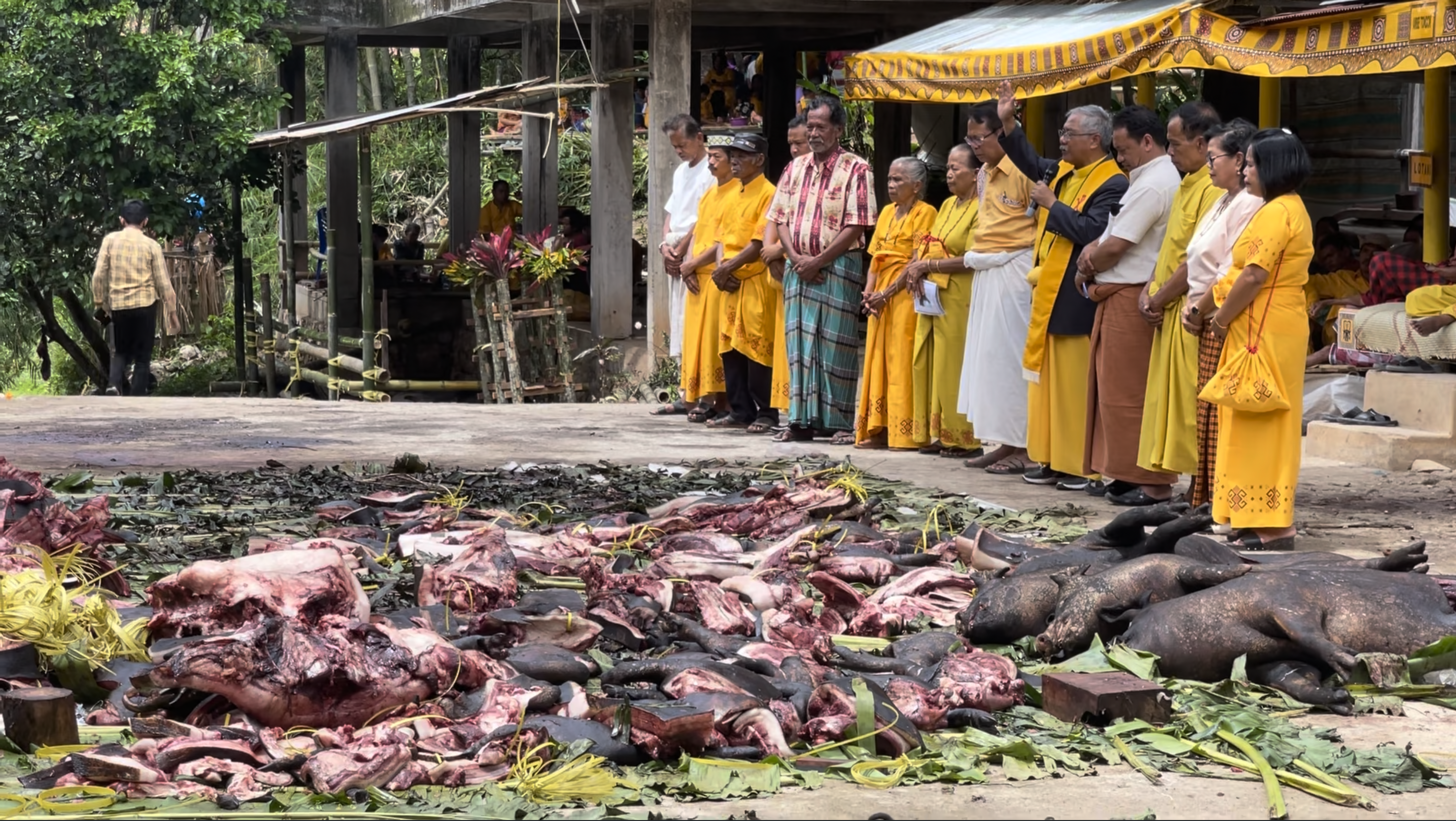
After finishing his sermon, Pastor Yusuf stepped down from the podium and walked across the heaps of pork. He turned to face the tongkonan and called together the representatives of the rapu, lining them up in a row. Then, raising one hand in a posture of invoking God's blessing, the pastor prayed in a notably archaic Torajan:
We give thanks, O Lord, our Creator.
Here the tongkonan stands well
In the name of the Lord our Father, Jesus, and the Holy Spirit,
here, the blood has been sprinkled on the tongkonan
The rapu together receive blessing,
and we shall be blessed in all our lives.
Pastor Yusuf did not sprinkle any blood on the tongkonan building. He merely raised one hand and prayed. And yet he declared that "here, blood has been sprinkled on the tongkonan." This prayer, which substitutes a performative14 utterance for the concrete act of mangrara (blood-sprinkling), is called a "Symbolization Prayer" (I: Doa Simbolisasi). What does it "symbolize"? The theological logic of this symbolization was something I later learned from Yohanes, a ritual orator.[^15] The blood of the pigs slaughtered at a mangrara festivity symbolizes the blood of kin and, further, the precious blood of Christ. It is this symbolic blood that consecrates the tongkonan as a building symbolizing the bonds of kinship and Christian love.
The Symbolization Prayer is, in this way, "symbolic" in multiple senses. First, this prayer takes effect by being uttered immediately after the Word has been proclaimed and contextualized through the sermon. The symbolic force of the Word underwrites the performative force of the prayer. Borrowing the force of the "symbolic" Word, the Symbolization Prayer sprinkles "symbolic" blood on the tongkonan in the name of the most exalted among Christianity's "symbolic" vocabulary—the name of the Father, the Son, and the Holy Spirit. Just so, the mangrara—once a ritual of shedding pig's blood—converts into a ritual of Christian symbolism.
The mangrara ritual of Tongkonan Lumba'et was an event at which the representations of two quite heterogeneous "houses" were superimposed upon one another. Pongintan's speech represented the house of the ancestor Ne' Pokkate as a house that had flourished like a great tree, like a grove of bamboo—and presented it as a forest of houses that deserve to become a tongkonan. By contrast, the Word that Pastor Yusuf proclaimed represented the same house as a House of Word in which the Word of God resounds. In the former, the house resembles and points to people and trees; in the latter, the house stands as a symbol at the heart of a Word that speaks in symbols.
The mangrara ritual of Tongkonan Lumba'et was an event at which the representations of two quite heterogeneous "houses" were superimposed upon one another. Pongintan's speech represented the house of the ancestor Ne' Pokkate as a house that had flourished like a great tree, like a grove of bamboo—and presented it as a forest of houses that deserve to become a tongkonan. By contrast, the Word that Pastor Yusuf proclaimed represented the same house as a House of Word in which the Word of God resounds. In the former, the house resembles and points to people and trees; in the latter, the house stands as a symbol at the heart of a Word that speaks in symbols.
In this way, by sharing a place at the mangrara festivity, the two houses draw closer to becoming "one house." The Torajan logic of fellowship—in which multiple houses become "one house" by going back and forth from house to house—was also the logic that ran through this Christianized mangrara festivity. The rapu welcomed the guests, urging them to become the family of one great "house" that leaves no one "outside the wall, outside the house."15 Likewise, by welcoming the people who had come from the church—the "House of Word"—the rapu made their tongkonan into a House of Word in the likeness of the church, so that the tongkonan and the church might become "one house."
Yet neither Pongintan's ritual speech nor the church's worship quite reaches the fullness of hospitality. At the outset I wrote that the "main part"—the worship—was yet to come. Yet mangrara is not only a ritual but also, and before a ritual, a festivity. The prosperous rapu of Tongkonan Lumba'et and the throngs of guests gathered in the front yard of the tongkonan not merely to hold a ritual, but above all to enjoy an animated festivity. Pastor Yusuf said, "It is (...) to strengthen the bonds of flesh and blood that we have gathered." Indeed so, but to strengthen the "blood and bones" of kinship, many people must eat and drink together amid the animation of the festivity. The mangrara is not over. The festivity is yet to come.